Booby: The Industrial Typeface Built for Impact
There is a specific kind of visual authority that comes from things built to last—steel girders, shipping containers, heavy machinery, and reinforced concrete. When you are crafting a brand identity, you often need to borrow that sense of permanence and strength without necessarily being in the construction business. This is where typography does the heavy lifting. It is not just about legibility; it is about the immediate impression of grit, reliability, and utility. For designers and entrepreneurs aiming to project an image of robust capability, finding a font that embodies the "industrial-and-utilitarian" soul is a game-changer.
Capturing the Industrial Soul
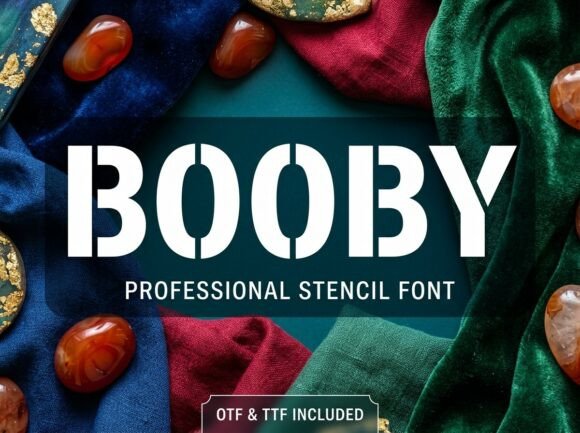
Booby is a premium font that steps directly into this space with a rock-solid geometric structure. It is a display typeface defined by its thick, condensed sans-serif letterforms. If you look closely at the character set, you will notice the defining feature: rhythmic stencil gaps. This design choice mimics the look of lettering painted on wooden crates or stamped onto heavy-duty equipment. It breaks up the heavy visual weight of the letters, allowing for high-impact presence without becoming a visual wall of ink.
The appeal of this typeface lies in its refusal to be delicate. It does not whisper; it commands. The geometry is strict, offering clean, professional lines that feel modern yet nostalgic for an era of manual labor and craftsmanship. For anyone working in modern typography, understanding how to utilize a font with this much "weight" is essential. It is the visual equivalent of a firm handshake. Whether you are designing tactical equipment logos or artisanal workshop signage, the font provides a foundation that feels unshakeable.
Visual Consistency and Brand Recognition
One of the biggest challenges in branding is maintaining visual consistency across different mediums. A logo that looks great on a business card often falls apart when scaled up for a billboard or becomes illegible on a mobile screen. Booby solves this through its high-impact presence. Because the letterforms are condensed, they occupy less horizontal space while maintaining maximum vertical impact. This makes it an exceptional choice for logo design, particularly for brands that need to fit a long name into a tight space without sacrificing readability.
Consider the "cargo-and-craft" aesthetic that is currently dominating social media and independent retail. Brands want to look handmade but professional, tough but approachable. By using a display font like Booby, you immediately signal to your audience that your brand is grounded and serious about its craft. It helps build brand recognition because the stencil gaps and bold structure are distinct enough to be remembered. When a potential customer sees that typography on a social media header or a website banner, they instantly associate it with the rugged reliability you are selling.
Practical Applications: From Packaging to Pixels
The versatility of a strong display font lies in how well it translates across different assets. Booby is not just for digital screens; it shines in tactile environments. Here is how you can practically apply this typeface across your creative projects:
- Packaging Design: If you are shipping products, the "industrial" look is perfect for creating labels that look like vintage shipping manifests or inventory stickers. It adds a layer of authenticity to product packaging.
- Merchandise and Apparel: Bold, condensed sans-serif fonts are the backbone of streetwear and workwear. Booby works beautifully screen-printed on the back of heavy cotton hoodies or embroidered on mechanic caps.
- Web Design and Blogs: While it is too heavy for body text, it is perfect for headers and navigation menus on websites that focus on DIY, architecture, or outdoor gear. It provides a strong visual anchor for your layout.
- Editorial Layouts: In magazine design or digital lookbooks, using Booby for pull quotes or section titles can break up the monotony of standard serif font or body text, adding energy to the page.
- Social Media Graphics: The "thumb-stopping" power of a font is real. On platforms like Instagram or TikTok, where users scroll rapidly, a thick, stencil-gap header is more likely to catch the eye than a delicate script font.
Typography Pairing and Hierarchy
Using a display font with this much personality requires a bit of strategy. You rarely want to pair two loud voices in the same room. Since Booby is bold and condensed, it pairs best with something that offers contrast but doesn't compete for attention.
A classic pairing strategy involves matching this heavy sans-serif with a simple, clean serif font or a neutral sans-serif for your body copy. For example, if you are designing a menu for a craft brewery, you might use Booby for the section headers like "Burgers" or "IPAs," but switch to a highly legible, standard sans-serif for the descriptions and prices. This creates a clear hierarchy: the big, bold font grabs attention, and the smaller font delivers the information.
Avoid pairing it with a highly decorative script font or a handwritten font, as the visual clash can make the design feel chaotic. The goal is to let the industrial nature of Booby stand out against a clean background. Think of it as the heavy machinery in the foreground, with a clean skyline behind it.
Readability Considerations
It is important to recognize the intended use of a typeface like this. Booby is a display font, meaning it is designed for large sizes—headlines, logos, and headers. It is not intended for paragraphs of body text. The heavy weight and stencil gaps that make it look cool at 48pt can make it difficult to read at 10pt.
When designing for the web, ensure that your headings are large enough to allow the stencil gaps to register clearly. If the text is too small, the gaps may fill in visually, making the letters look like strange blobs rather than distinct characters. Always test your designs at the actual size they will be viewed. For print materials, such as posters or invitations, check the kerning (spacing between letters) to ensure the rhythm feels right. Sometimes, condensed fonts need a little manual tracking adjustment to look perfect in specific contexts.
Licensing and Commercial Use
For entrepreneurs and small business owners, the technical side of design assets is just as important as the creative side. When you invest in a creative font like Booby, you are usually acquiring a commercial license. This is a crucial distinction from free fonts found on random websites.
A commercial license typically covers you for using the font in projects where you are making money—logos, client work, merchandise, and advertising. It protects you legally and ensures that the font creator is compensated for their work in crafting those unique geometric structures and stencil gaps. Before purchasing, always review the specific license terms to see if it covers the number of users or the types of products (e.g., print-on-demand vs. digital products) you plan to create. This due diligence is part of running a professional design operation.
Final Thoughts on Industrial Aesthetics
Design trends come and go, but the aesthetic of utility and strength is timeless. We see it in architecture, in fashion, and increasingly in digital branding. Using a typeface like Booby allows you to tap into that visual language of resilience. It is a tool for designers, marketers, and creators who want their work to feel grounded, authentic, and built to last. Whether you are revamping a construction company’s identity or launching a new line of artisanal leather goods, this font offers the structural integrity your designs need to stand out in a crowded market.